MECHATRONICS ENGINEER
A Career Built on Curiosity and Courage
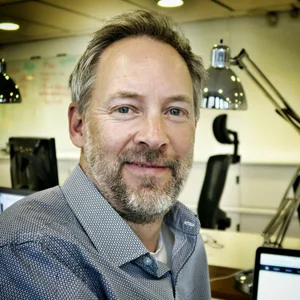
From Mexico City to Stockholm’s fusion frontier, Novatron Fusion Group engineer Bruno Verde has built a career around curiosity, experimentation and the courage to tackle problems with no obvious solution. As part of Novatron’s Engineering Integration team, he sits at the crossroads of science and engineering translating ambitious ideas into working systems, helping transform fusion research into practical reality.
But Bruno’s journey into fusion did not begin with plasma physics textbooks or childhood dreams of energy systems. It began with a fascination for building things.
Growing up in Mexico City, Bruno was the kind of child who wanted to understand how everything worked. Like many future engineers, he gravitated toward construction toys, electronics and problem-solving challenges. That instinct evolved naturally into robotics competitions during his teenage years, where he began designing and building increasingly sophisticated machines.
“Since high school I was already involved in robotics competitions. Different sizes, different types of robots, competing both in Mexico and internationally.”
Those competitions eventually took him to the United States, including events in San Francisco, giving him an early taste of international engineering collaboration and high-performance technical environments. The experience cemented something important, Bruno was not only fascinated by engineering theory, but by the process of building functioning systems under pressure.
That hands-on mentality led him to study Mechatronics Engineering in Mexico, a discipline that combines mechanics, electronics, software and automation into one broad engineering toolkit. It would later become one of his defining strengths.
Unlike specialists focused on a single discipline, Bruno developed a systems-level mindset early in his career. He describes himself as someone with “broad knowledge” across mechatronics, automation, process engineering and systems design, an approach that would prove invaluable in fast-moving deep-tech environments.
One of the most formative experiences of his early career came through Formula Student, the globally recognized university engineering competition where teams design and build small-scale Formula One-style race cars. Bruno helped establish his university’s Formula Student team from scratch in Mexico, a challenge that required far more than technical design work. The team had to secure funding, recruit people, organize logistics and build a competitive vehicle under enormous uncertainty.
“We started the team for the first time and competed in Los Angeles. We won Rookie of the Year and placed 26th out of around 80 teams.”
The achievement remains one of the defining milestones of his early career not simply because of the result, but because it taught him how to build ambitious projects from the ground up. Many of the same lessons still apply in fusion today, navigating uncertainty, solving unfamiliar problems quickly and collaborating across disciplines.
Crossing Continents and a Masterclass in Applied Engineering
Bruno’s next major step took him far from Mexico.
Drawn by Sweden’s reputation for innovation and advanced engineering, he moved to Scandinavia to pursue a master’s degree in Engineering Design. Sweden had already captured his imagination years earlier, when he initially hoped to complete an Erasmus exchange there during his bachelor studies.
“I already had this idea that Sweden was innovative and a cool country. That interest stayed with me.”
After completing his master’s degree, Bruno joined another Swedish deep-tech startup focused on next-generation solar cell technology. He spent seven years there helping build highly specialized manufacturing systems for an entirely new type of solar cell production line.
The role became a masterclass in applied engineering.
Working closely alongside scientists and researchers, Bruno helped design machines and processes that had never existed before. The company’s vertically integrated approach combining advanced science, engineering and rapid experimentation strongly shaped the way he works today.
“We had a lot of freedom to experiment and build machines that had never been built before,” he explains. “You learn how to work with uncertainty and how to support rapid development.”
That experience also taught him how to bridge the gap between research teams and engineering teams, an increasingly critical skill in the fusion sector, where scientific theory must constantly be translated into practical hardware and operational systems.
A mysterious phone call
In many ways, it prepared him perfectly for Novatron.
The opportunity arrived unexpectedly during parental leave. Bruno still vividly remembers the moment he received a mysterious phone call from a former colleague connected to Novatron’s earliest team members.
“I was in the park with my daughter,” he recalls. “He told me there was something really cool he wanted me to be part of, but he couldn’t tell me what it was yet.” After signing an NDA and meeting the founding team, Bruno quickly recognized both the ambition and the challenge ahead.
“My first thought was: this is ambitious, maybe too ambitious,” he says with a smile. “But the people were incredibly smart, the atmosphere was very open and the team dynamic was excellent. It felt worth trying.”
At the time, Novatron had only around 10 or 11 employees. Bruno became one of the company’s earliest engineers, joining at a pivotal stage where every hire helped shape both the technology and the culture.
Today, as part of the Engineering Integration team, Bruno works on turning complex experimental systems into functioning machines capable of supporting fusion research at increasing levels of sophistication.
Thriving on Complexity, Uncertainty and Collaboration
One of the defining milestones during his time at Novatron has been helping bring the company’s first experimental machine online.
“For the whole team, getting the machine operational was a huge milestone. We worked within a lot of constraints around resources, people, space, time, and still managed to build a functioning plasma experiment in a reasonable amount of time.”
For Bruno personally, some of the most demanding work has involved testing and commissioning integrated systems ensuring different components operate together reliably under highly experimental conditions.
His role today spans both present and future systems development. While supporting ongoing experimental work and machine upgrades, he is also helping prepare for Novatron’s next-generation systems, which will operate at significantly larger scales and power levels.
It is exactly the type of challenge he thrives on: complex, uncertain and collaborative.
Despite now working in fusion full-time, Bruno remains refreshingly pragmatic about the industry. He acknowledges both the extraordinary potential of fusion energy and the immense engineering challenges still ahead.
“What excites me is the complexity. There are still so many fascinating problems to solve.”
Opportunities for Engineers Across Every Discipline
Importantly, Bruno believes fusion is no longer a field reserved only for physicists and academic researchers. As the industry matures, he sees growing opportunities for engineers across every discipline.
“There’s a need for everyone,” he says. “Mechanical engineers, electronics engineers, systems engineers. The whole engineering development chain is needed.”
That broader perspective reflects Bruno’s own career path. Not a narrow technical specialism, but a combination of adaptability, curiosity and practical engineering experience applied across multiple industries and technologies.
Outside the lab, Bruno has embraced Swedish life wholeheartedly. He decompresses through long bike commutes through Stockholm’s nature, running and renovating a countryside home, a contrast to the intensity of fusion engineering.
“It’s a huge difference,” he says of cycling through nature each day. “You arrive fresh, and then you decompress again on the way home.”
That balance between intensity and calm perhaps captures Bruno’s personality best. Thoughtful but highly practical, ambitious yet grounded, he represents the type of engineer modern deep-tech companies increasingly depend upon – people capable of navigating uncertainty while steadily building the future one system at a time.
And whether commercial fusion arrives in the short term or beyond, Bruno is comfortable with the long view.
“If you contributed even one grain of sand pushing things forward,” he says, “then it matters.”